
Natural & Wellness Ingredients
Makhana (Fox Nuts) & Makhana Powder
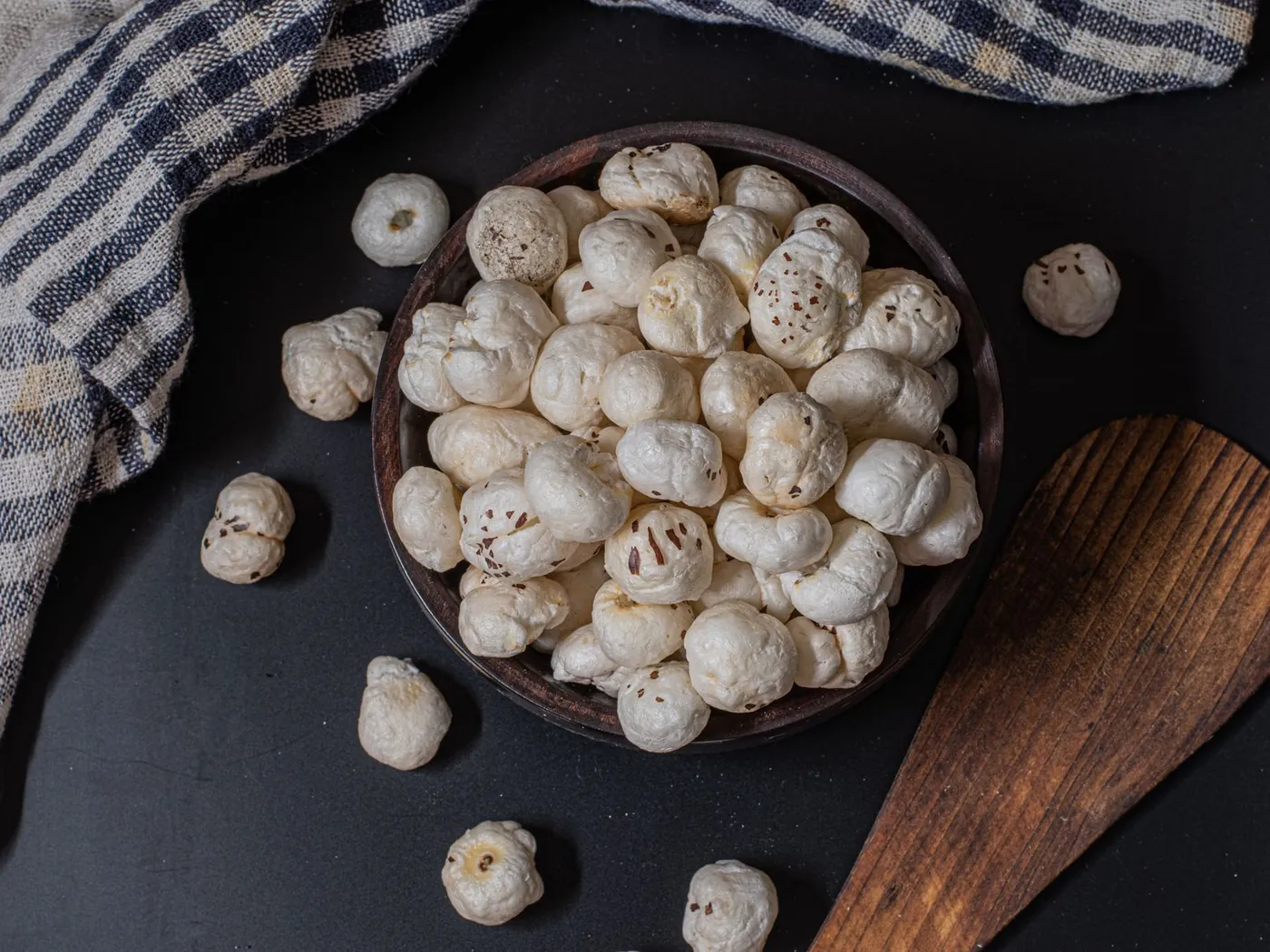
Popped fox nuts graded by Suta size, and makhana powder.
Overview
Makhana, also sold as fox nuts or phool makhana, is the popped seed of the water lily Euryale ferox. It is graded by size using the traditional Suta scale, and the grade largely decides both the end use and the price.
DVG supplies popped makhana from 4 Suta to 7 Suta and above for snacking and retail packing, a smaller-size processing grade for flour and sweets, and makhana powder. India origin.
Forms, grades & specifications
Suta is the traditional size unit for popped makhana: 1 Suta ≈ 3.175 mm (1/8 inch). A higher Suta number means a larger, more fully popped kernel. Size bands are indicative and exact cut-offs are confirmed per lot.
Super Jumbo, 7 Suta and above
Super jumbo / extra-large popped makhana, the top export tier for premium direct snacking and gifting.
| Suta grade | 7 Suta and above |
|---|---|
| Approx. size | > 21 mm |
| Trade name | Super Jumbo / Extra-Large |
| Typical use | Premium direct snacking, gifting |
| Origin | India |
Jumbo / Export Grade, 6 Suta
Fully popped “Phool” makhana, the primary export grade for premium retail snacking.
| Suta grade | 6 Suta |
|---|---|
| Approx. size | 18–21 mm |
| Trade name | Jumbo / Export Grade, Phool |
| Colour | Bright white, uniform, minimal seed-coat residue |
| Typical use | Premium retail snacking |
| Origin | India |
Standard, 5 Suta
Good standard retail grade for mainstream branded retail and mid-tier export.
| Suta grade | 5 Suta |
|---|---|
| Approx. size | 15–18 mm |
| Trade name | Good / Standard retail |
| Typical use | Mainstream branded retail, mid-tier export |
| Origin | India |
Regular / Bulk, 4 Suta
Economical regular grade for value retail, bulk and base export.
| Suta grade | 4 Suta |
|---|---|
| Approx. size | 12–15 mm |
| Trade name | Economical / Regular, bulk |
| Typical use | Value retail, bulk domestic, base export |
| Origin | India |
Processing Grade, 2–3 Suta (Lava / Thurri)
Smaller, often incompletely popped kernels sold as a raw material for processing rather than whole-kernel snacking.
| Suta grade | 2–3 Suta, Lava / Thurri |
|---|---|
| Approx. size | < 12 mm, often incompletely popped |
| Typical use | Flour, namkeen mixes, sweets, kheer |
| Origin | India |
Makhana Powder (Flour)
Makhana flour / powder for sweets, kheer, namkeen mixes and other processing uses. Mesh and technical specification are confirmed per order.
| Form | Makhana flour / powder |
|---|---|
| India HS code | 2008.19.22 |
| Typical use | Flour, sweets, kheer, namkeen mixes |
| Mesh / specification | On request |
| Origin | India |
Applications
- Premium direct snacking and gifting
- Branded and value retail packs
- Flour, namkeen mixes, sweets and kheer
Packaging & commercial
- Bulk export: PP / HDPE woven bags with a food-grade inner liner, typically 5–15 kg. Plain jute alone is not an adequate moisture barrier.
- Retail and private label: tins, glass jars, PET / PVC bottles and laminated stand-up pouches (50–250 g).
- Vacuum-sealed or nitrogen-flushed multi-layer laminate pouches can extend freshness on long transits.
- Popped makhana is light and bulky, so a container usually fills by volume before it reaches its weight limit. The loading plan is confirmed with the freight forwarder against the packed bulk density.
Origin & sourcing
Makhana is traditionally grown and processed in Bihar, and “Mithila Makhana” has held a Geographical Indication (GI) tag since 2022. A GI claim only applies to product sourced and documented from the GI region, so origin details are confirmed lot by lot rather than assumed.
Quality & documentation
- Each lot is checked for Suta grade and sieve-size distribution, moisture, broken / immature percentage, foreign matter and colour.
- Lab testing covers total plate count, yeast and mould, E. coli, Salmonella, coliforms, aflatoxin (total and B1), heavy metals (lead, arsenic, cadmium, mercury) and a multi-residue pesticide screen.
- A Certificate of Analysis (COA) is available on request for each shipment.
Export information
- India HS codes
- 2008.19.21 (popped makhana), 2008.19.22 (makhana flour / powder), 2008.19.29 (other makhana products), in force since July 2025. Confirm the exact code with your customs broker.
- Documents
- Commercial invoice, packing list, Certificate of Origin, phytosanitary certificate where the destination requires it, and a lot-specific COA.
- Samples and MOQ
- Samples can be arranged for approval. Minimum order quantity and packing are agreed per enquiry.
Questions buyers ask
What does “Suta” mean?
Suta is the traditional size unit for popped makhana, roughly 3.175 mm (1/8 inch) per Suta. A higher Suta number means a larger, more fully popped kernel, which usually means a higher price and a more premium end use.
What is the difference between phool and lava makhana?
Phool makhana is fully popped, round, bright white and uniform, and is the premium snacking and export material. Lava makhana is smaller, irregular and often incompletely popped, and is typically ground into flour or used in sweets and gravies.
Which grade is used for makhana powder?
Smaller, incompletely popped kernels (the processing grade) are the grade normally used for flour. The mesh and specification of powder are confirmed per order.
How is makhana packed for export?
Bulk lots are packed in PP or HDPE woven bags with a food-grade inner liner, usually 5–15 kg. Retail packs use tins, jars or laminated pouches, and vacuum or nitrogen-flushed pouches can be used for long transits.
Related knowledge
All Makhana & Makhana Powder articles
Other products
Ready to talk about Makhana & Makhana Powder?
Tell us the grade, quantity and destination port. We will confirm what we can supply.